Not every problem tree needs to come down. Some trees that look rough on the outside can be treated, pruned, or managed. Others that look healthy at a glance are structurally compromised and genuinely dangerous. Knowing which situation you are dealing with makes a real difference, both for your property and your budget.
This guide covers the signals that point toward removal, the signals that suggest a tree can be saved, and the situations where you need a professional assessment before making any decision.
Start Here: Why the Decision Matters
Trees add real value to a property. Mature shade trees can reduce energy costs, improve curb appeal, and increase home value. Removing a tree unnecessarily is a cost with no upside.
But keeping a hazardous tree because of sentiment or uncertainty is a different kind of cost. Dead and structurally compromised trees fail without warning. In Indianapolis and the surrounding suburbs, spring and summer storms routinely bring down trees that were already compromised. A tree that falls on a roof, fence, or vehicle is a much more expensive problem than the removal would have been.
The goal is to make the right call, not just the cautious one.
Clear Signs the Tree Should Come Down
Some situations do not require much deliberation. Removal is the right answer when any of the following apply.
The tree is dead or more than 50 percent dead
Dead trees lose structural integrity quickly. Wood that was alive last year can become brittle and unpredictable within a season or two. If a tree has no leaves during the growing season, has significant bark loss, or has large sections of dead wood throughout the canopy, it is likely past the point of recovery.
A common rule of thumb: if more than half the tree is dead or dying, removal is almost always the better decision than trying to save it.
The trunk has significant structural damage
Cracks that run vertically through the trunk, large cavities or hollow sections, and multiple co-dominant stems with included bark are all signs of structural weakness. These are not cosmetic issues. They are failure points.
Leaning trees are also a concern, particularly after a storm or a period of saturated soil. A tree that has shifted its lean or shows soil heaving around the base may have already started to uproot.
The root system is compromised
Root problems are often invisible until something goes wrong. Signs to watch for include soil heaving or cracking around the base, fungal growth at the base of the trunk (often a sign of root rot), and construction damage from excavation or paving within the drip line of the tree.
A tree with a failed root system can fall even in moderate wind. It may look perfectly fine from the outside.
The tree is in contact with or growing into a structure
Roots lifting sidewalks, driveways, or foundations are a progressive problem that does not resolve on its own. Branches growing into power lines or resting against a roof are a safety and liability issue. In these situations, removal is often more practical than repeated trimming to manage the problem indefinitely.
The tree has been severely damaged by a storm
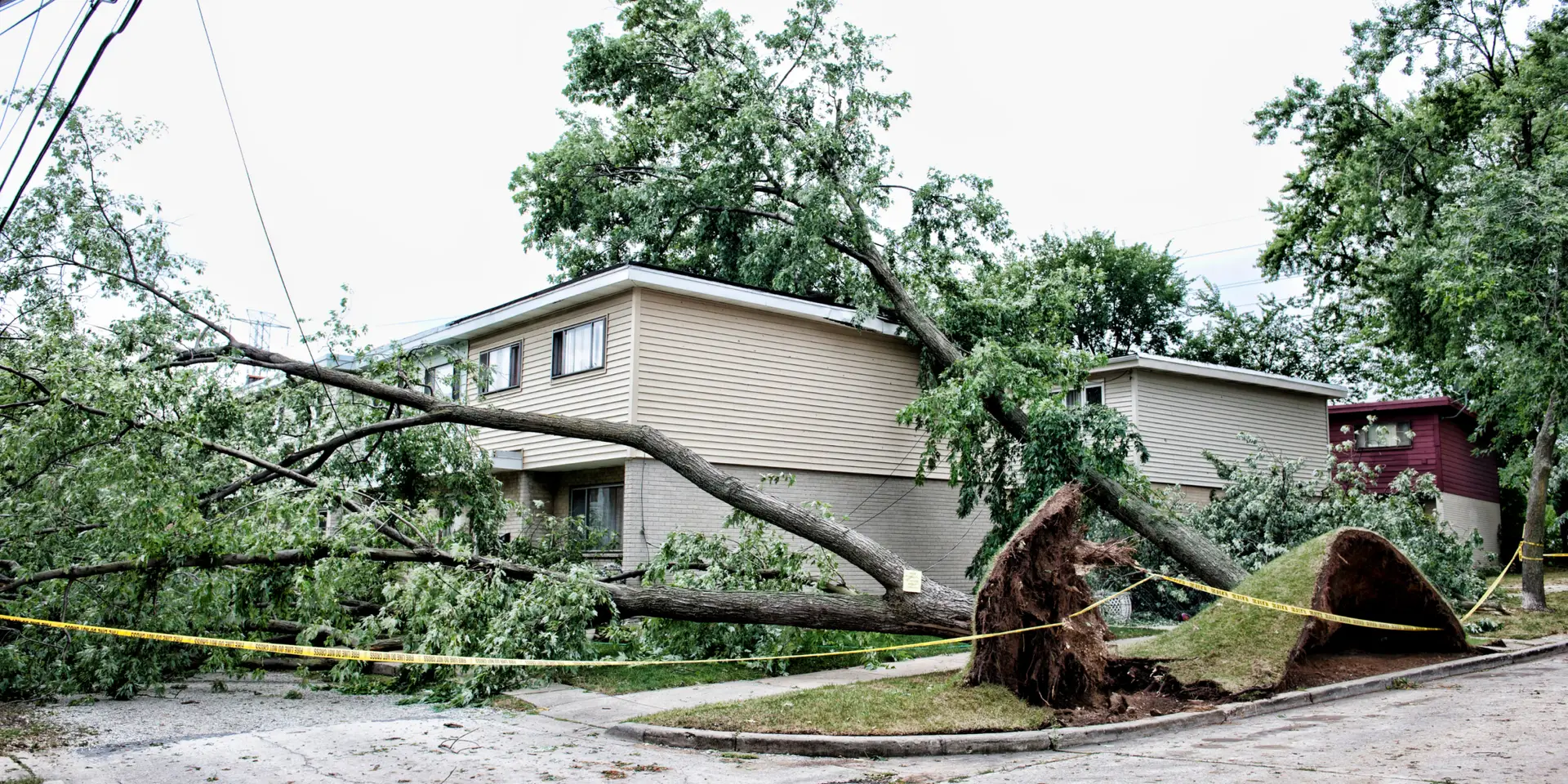
Storm damage is one of the most common reasons homeowners in Central Indiana call us. Our emergency storm damage page covers the response process, but the short version: a tree that has lost more than a third of its canopy, has a split or cracked trunk, or is partially uprooted after a storm should be evaluated immediately. Many of these trees cannot be saved, and leaving them standing creates ongoing risk.
| Remove the tree if… | Consider saving the tree if… |
| More than 50% of the tree is dead | Damage is isolated to one or two branches |
| The trunk has large cracks or hollow sections | The trunk and root system are structurally sound |
| Roots are lifting foundations or driveways | The problem is cosmetic or limited to the canopy |
| The tree is leaning after soil movement or storm | Lean has been stable for years with no soil movement |
| The tree is dead and in the fall zone of structures | Tree is healthy but needs corrective pruning |
| Disease or infestation has spread through the crown | Disease is caught early and treatable |
When a Tree Can Often Be Saved
Removal is not always necessary. Trees with isolated problems, healthy root systems, and good overall structure are often worth treating or pruning rather than removing.
The damage is limited to specific branches
Deadwood, storm-damaged limbs, and crossing or rubbing branches can all be addressed through selective pruning without removing the tree. If the trunk is sound and the root system is healthy, a good pruning job can extend the life of the tree significantly and reduce the chance of branch failure.
The tree has a treatable disease or pest problem
Some of the most common tree diseases and infestations in Indiana, including Emerald Ash Borer, oak wilt, and certain fungal infections, can be managed if caught early enough. Treatment is not always effective and is not always worth the investment for a tree in poor overall condition, but it is a real option for otherwise healthy trees.
If you suspect disease or infestation, a professional assessment is worth scheduling sooner rather than later. Early intervention gives you options. Late intervention usually does not.
The tree is structurally sound but poorly shaped
Trees that have grown unevenly, developed poor branch architecture, or become overgrown are often good candidates for corrective pruning rather than removal. Improving the structure of a younger or mid-age tree can add decades to its useful life and reduce storm damage risk at the same time.
The tree has sentimental or practical value
Mature trees are not replaceable on a short timeline. A 60-year-old shade oak that is providing real cooling value in the summer is worth trying to save if the problem is manageable. Weigh the cost of treatment and the likelihood of success against the cost of removal and the years it would take a replacement to reach maturity.
The Gray Area: When You Need a Professional to Look
Many situations do not clearly point in one direction or the other. If you are dealing with any of the following, the right next step is an in-person assessment before making a decision.
- A tree that leans but has always leaned, and you are not sure if it has shifted
- A tree with a cavity or hollow section of unknown depth and extent
- A tree that lost significant canopy in a storm but still has green growth
- A tree near a structure where the margin for error is small
- A tree you want to save but are not sure is worth the investment
We do free on-site assessments across our entire service area. An assessment gives you an honest read on whether the tree is a candidate for removal, pruning, or treatment, and what each option would cost. There is no pressure in either direction.
What Happens After the Decision
If you decide to remove
Our Indianapolis tree removal service covers the full process, from permit handling through cleanup and debris removal. Most residential removals are completed in a single day. We also offer stump grinding as a separate service if you want the stump taken below grade after the tree comes down.
If you decide to save it
We can handle corrective pruning, deadwood removal, and structural trimming. For disease or pest treatment, we can advise on the appropriate course of action and connect you with the right resources if the treatment falls outside our scope.
If the tree is in an emergency situation
If the tree is actively threatening your property or has already caused damage, do not wait on an assessment. Call us directly at (317) 910-9563 or visit our emergency storm damage page. We provide 24/7 emergency response across Central Indiana.
Not sure what your tree needs? Request a free on-site assessment and we will walk the property with you at no charge.
A Note on Indianapolis-Area Trees Specifically
Central Indiana has a mix of native hardwoods, ornamental plantings, and suburban trees that each come with their own considerations. A few worth knowing about:
- Ash trees: Emerald Ash Borer has been active in Indiana for years and has killed a significant portion of the ash tree population in the Indianapolis suburbs. If you have ash trees that have not been treated, have them assessed. Untreated ash trees often fail suddenly.
- Silver maples: Common throughout older Indianapolis neighborhoods and the inner suburbs. They grow fast, which is part of the appeal, but fast-growing wood is often weaker. Silver maples are prone to branch failure in ice storms and heavy wind events.
- Bradford pears: Widely planted in suburban developments across Hamilton and Johnson County. They have a structural weakness at the crotch of major branches that makes them prone to splitting as they mature. Many arborists recommend removal once they reach a certain size.
- Large oaks and hickories: Generally very long-lived and worth significant effort to preserve when the structure is sound. These trees are worth a professional evaluation before making a removal decision.
Understanding what species you have and what its common failure patterns are is part of making a good decision. When we assess your tree, this is part of what we look at.
We Serve All of Central Indiana
Pro Finish Tree Care provides tree removal, trimming, stump grinding, and emergency storm response across Indianapolis, Fishers, Carmel, Noblesville, Westfield, Greenwood, and surrounding communities. We are a veteran-owned, family-operated business that has worked in this area since 2019. Owner Jesse Dickson is on every job.
Learn more about who we are on the About Us page, or browse real completed work in our Past Projects gallery.
Ready to get a professional read on your tree? Contact us for a free estimate at (317) 910-9563. No obligation, no pressure.
How do I know if my tree is dead or just dormant?
Scratch a small section of bark on a branch. Living wood underneath will be green or white and slightly moist. Dead wood will be dry and brown all the way through. Check multiple branches in different parts of the canopy before concluding the whole tree is dead.
Can a tree recover from storm damage?
It depends on the extent of the damage and where it occurred. A tree that lost a major limb but has a sound trunk and healthy canopy elsewhere can often recover with proper pruning. A tree with a split trunk or significant root disturbance is much harder to save and usually should come down.
Is it worth paying to treat a diseased tree?
Sometimes. Treatment makes the most sense when the tree is otherwise healthy, the disease is caught early, the tree has significant value to the property, and the cost of treatment is reasonable relative to the cost of removal and replacement. We can help you think through that tradeoff during an assessment.
What if my neighbor’s tree is the one that looks dangerous?
This is a common situation in Indianapolis neighborhoods and suburbs. If a neighbor’s tree is visibly dead, leaning toward your property, or has significant structural problems, document what you see and bring it to your neighbor’s attention in writing. If the tree falls and causes damage, liability generally follows the owner’s knowledge of the hazard. Consulting a professional and having a written record of the hazard is in your interest.
Do you handle permit requirements for tree removal in Indianapolis?
Yes. Some Indianapolis neighborhoods and municipalities require permits for removing certain trees, particularly in historic districts or public easements. When we assess your job, we will advise you on any permit requirements and handle the paperwork. See our full Indianapolis tree removal service page for more details.